Features:Three-sided corner mirror. Trihedral corner mirror is an optical element composed of a concave lens and three different angles (73°, 67 °, 59 °). The following figure shows the appearance of the case when it comes in contact with the eyes, and b is the plan view.When in use, the surface of the concave lens was pressed against the cornea and observed with a slit lamp microscope. In the picture:1 To view the light path in the center of the retina;2 To view the light path from the area around the center to the equator;3 To view the light path from the equator to the front of the
Features:1. Small, portable and proven to be accurate by several independent clinical studies2. No need for anesthetic3. Both horizontal and vertical measuring terms4. Wireless transmission printing5. With angle transducer inside6. One-off probe no cross infection7. Keep good precision8. During every measurement, there are 3 measuring datas on the disaplay, and the machine may calculate the average dataautomatically as the final result.9. With Infrared Printer --- Print measring data by wireless transmission---Free10. With 100 pieces of probes --- Free11. It may store 2000 medical cases of
Features:5 Step MagnificationLED IlluminationMore than 50 000 hours working timeReduce eye's stressProvide bright and sharp lightContinuous illumination controlPossible accessoriesYellow filterOptical System LS-4Type: Galilean system, Parallel type, Haag-streit typeMagnification Changer: Rotating drum changeMagnification: 6X 10X 16X 25X 40XEyepiece: 12.5XField of view: 6x(φ33) 10x(φ22) 16x(φ14) 25x(φ8.5) 40x(φ5.5) mmPupil Range: 52 - 82 mmDiopter: ±7DlluminationSlit Width: Continuous from 0 to 14 mmSlit Length: Continuous from 1 to 14 mmSlit angle: 0° - 180°Slit Aperture: Continuous from 1 - 1
Features:Microscope LS-1BType Binocular Portable Slit LampAngle of Convergence 13°Magnification 10X 10X 16X Working Distance 80mm (16X) 100mm (10X)Pupil Adjustment Range 49 - 75 mm Diopter Adjustment ±7DIlluminationSlit Width 0.1mm, 0.2mm, 0.8mm & Φ1mm, Φ5mm, Φ12mm circle Slit Length 12mm (with width 0.1mm, 0.8mm), 8mm (with width 0.2mm) SlitAngle ±60°Filter Neutral Density, Red-free, Cobalt BlueLight Resource Warm LED, Color Temperature 3500k Illumination Control Continuously Variable from Low to Full Brightness ( ≥250 000 lux)Power (Battery)LED Working Voltage AA, 15VABattery Type AA
Features:Portable Digital Slit Lamp Microscope is produced with high illumination white LED, and can be used about 5 to 6 hours continuously after fully recharged. The net weight is 750g only, so that very convenient to be carried. And very proud that it is the very initial and most advanced portable model in China. With Nikon Camera & Camera adaptor & Background illumination & Fixation
Features:1.Ultra-portable: the ultra-portable is an excellent diagnostic instrument for examination of anterior segment structures andocular abnormalities. Its easy-to-operate optical system produces a high-brightness,continuously adjustable slit image ideal for prediatric and geriatric setting, emergency department screenings,ward rounds,beside exmination, post-op evaluations and mission work; 2.LED illumination: the first and the only portable slit lamp in the world applying LED illumination system.The most prominent advantage of our LED illumination system gives examiner the clearest image
Features:LCD Visual Acuity Chart An eye chart is a chart used to measure visual acuity. Eye charts are often used by health care professionals, such as physicians or nurses, to screen persons for vision impairment. Ophthalmologists, physicians who specialize in the eye, also use eye charts to monitor the visual acuity of their patients in response to various therapies such as medications or surgery.The eye test chart is placed at a standardized distance away from the person whose vision is being tested. The person then attempts to identify the symbols on the chart, starting with the larger
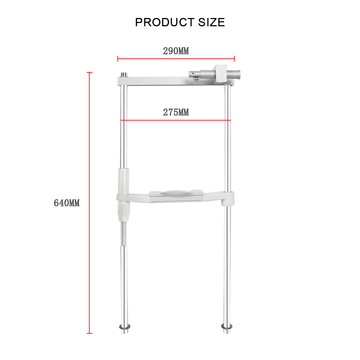
Features:1. This the holder / arm for Phoropter, not include the Phoropter.2. This item has two colors : Black and White.3. The holder can be put on the table.4. Packing size: standard export carton.1.1kg
Features:JG-1 Wall Mounted Phoropter Arm Specifications:Up/down angle of arm:±30°Rotate angle of arm:180°Max weight of phoropter arm:20kgMax weight on projector stand:10kgFeatures:1.Especially designed for small optometry room.2.Phoropter and projector two machines can be installed.NOTE:The mount doesn't come with User Manual. But please don't worry, because the installation is very easy.If you have any questions with our product, please feel free to contact us!The model is able to load a manual phoropter and a chart projector.Payment &
Features:1) Internal reading system;2) Prism compensation unit included;3) AC / DC power supply, more convenient.
Features:1.The silver ring on the lens holder should be held toward the patient's eye during examination, which can ensure theright using direction and may provide for best image quality;2.Keep the lens centring on the patients pupil;3. Hold the lens far enough from the patient's eye so that the retinal image has the same diameter with the lens;4.Keep the illumination sources as dark as possible to minimize reflections and image contrast;5.Keep the lens clean to minimize glare from the lens surfacePayment &
Features:YZ9 ExophthalmometerThe product can precisely measure the level of exophthalmia over the orbital margins. FeaturesThe product can precisely measure the level of exophthalmia over the orbital margins, on the principal basis that both vertexes ofcornea and scaleplate are projected to the front of prism by total reflection on the bevel, with the special structure of theisosceles right-angled triangle prism. SpecificationsMeasuring Range of the Exophthalmia: 0∼35mmAdjustable Range of the Orbital Distance: 80∼120mmPayment &
Features:1.The silver ring on the lens holder should be held toward the patient's eye during examination, which can ensure theright using direction and may provide for best image quality;2.Keep the lens centring on the patients pupil;3. Hold the lens far enough from the patient's eye so that the retinal image has the same diameter with the lens;4.Keep the illumination sources as dark as possible to minimize reflections and image contrast;5.Keep the lens clean to minimize glare from the lens surfacePayment &
view {{page_size}}
Sort by :{{pop_rules}}
Sort by :Popularity
Price: Low to High
Price: High to Low
Newest First
Popularity
Categories
{{cate.name}}
{{cate.name}}